




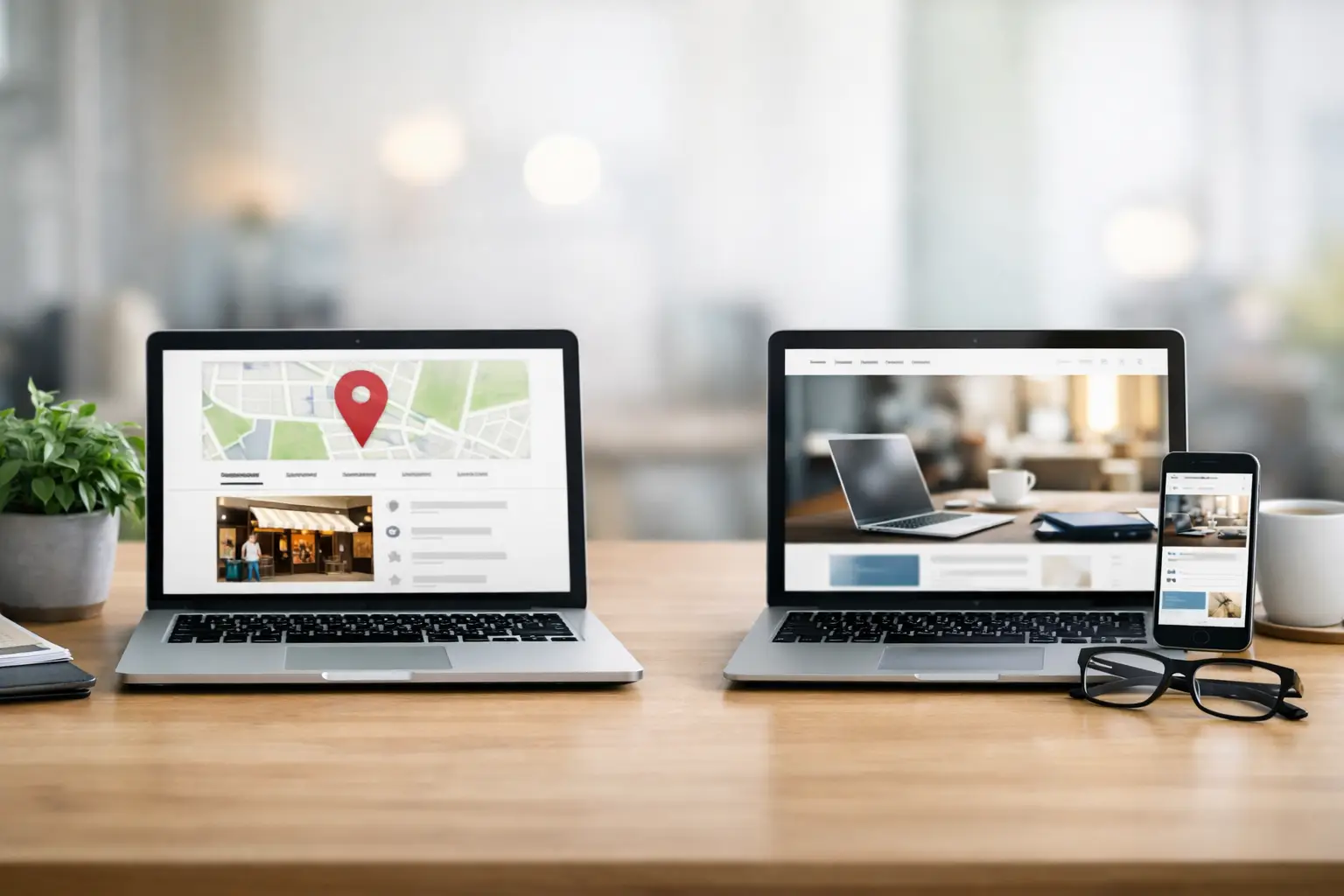
A customer in Stourbridge searches for an electrician, salon, accountant or café because they need an answer now. They may see the map results first, check opening hours, read a few reviews and call straight from their phone. That is why the question of Google Business Profile vs website matters – but it is rarely a case of choosing one or the other.
A Google Business Profile helps people find a local business at the moment they are searching. A website gives them the confidence and detail they need before they enquire, book or buy. Used together, they create a much stronger online presence than either can provide alone.
Google Business Profile vs website: the key difference
Your Google Business Profile is the listing that can appear in Google Search and Google Maps. It displays practical information such as your business name, telephone number, location, opening times, reviews, photographs and service categories. For a local firm, it is often one of the quickest routes to calls, direction requests and website visits.
Your website is your own digital home. It is where you decide how your business is presented, what services you explain, which work you showcase and what action a visitor should take. Unlike a profile, it is not limited to a standard Google layout or a small set of fields.
The simplest way to look at it is this: a Google Business Profile is brilliant for being found locally, while a website is where you make a convincing case for choosing you.
What a Google Business Profile does well
For many small businesses across the West Midlands, a well-managed profile is a valuable source of immediate local visibility. If someone searches for a nearby service, map listings can appear before the standard website results. A complete, accurate profile gives potential customers the essentials without making them hunt for them.
This is especially useful for businesses with a physical premises, a defined service area, or customers who often need a quick answer. A plumber can show the areas they cover. A retailer can confirm whether they are open. A restaurant can display current photographs and customer feedback. A professional service can make it easy for people to call or request directions.
Reviews are another major strength. A steady flow of genuine feedback can reassure someone who has never dealt with your business before. Replying professionally to reviews also shows that there are real people behind the listing who care about customer service.
However, a profile has limits. Google controls the format, the features available and how prominently your listing appears. A suspended, duplicated or incorrectly verified listing can affect visibility, and the rules can change. You should treat it as an important channel, not the sole foundation of your marketing.
Where a website has the advantage
A website gives a business room to answer the questions that stop customers from getting in touch. What exactly do you do? Which areas do you cover? What makes your approach different? How does the process work? What will it cost, where appropriate, and what evidence is there that you can be trusted?
A good website can include dedicated service pages, case studies, testimonials, galleries, team information, frequently asked questions and clear enquiry forms. It can work for the business around the clock, including when the office is closed. For an ecommerce business, it can also take payments and manage a full product range in a way a profile cannot.
It is also more adaptable as your business grows. You can add new services, target relevant local areas, publish useful advice and create landing pages for specific campaigns. That flexibility helps with search engine optimisation because Google has more useful, relevant information to understand and show to prospective customers.
Most importantly, your website is an asset you control. Provided it is properly hosted, maintained and secured, it remains your central platform even if a social media account changes direction or a third-party listing has a problem.
Why relying on only one can cost enquiries
A Google Business Profile without a website can create a credibility gap. A customer may find your phone number and reviews, but then want to see examples of your work, understand your credentials or compare your services with another local provider. If there is nowhere to send them, they may move on.
This can be particularly damaging for higher-value or considered purchases. Someone choosing a builder, financial adviser, legal service, web designer or commercial supplier is unlikely to decide from a listing alone. They need detail, proof and a sense that the business is established.
The reverse is also true. A smart, modern website with no maintained Google Business Profile can miss enquiries from people searching locally on their phones. If your hours are wrong, your address is missing, or you have few reviews compared with competitors, potential customers may never reach your website in the first place.
The balance depends on your business. A mobile emergency locksmith may see a high proportion of calls from map results. A specialist manufacturer may rely more heavily on detailed website content and targeted search terms. Even so, both still benefit from an accurate profile and a credible site.
How the two should work together
The strongest approach is to make the journey between your listing and website straightforward. Your business name, telephone number, address or service area and opening times should be consistent. Inconsistent information can confuse customers and make it harder for search engines to trust what they see.
Your profile should link to the most relevant page on your website, usually the homepage for a general listing. If you run a specific campaign, a carefully built campaign page may be more suitable. The page must load quickly on a mobile, clearly reflect the service being promoted and make contacting you easy.
Photographs should support the same message across both platforms. For example, a local roofing company might show completed work, branded vehicles and its team on site. A beauty salon could show the treatment environment, staff and examples of work, subject to customer permission. Real imagery is often more persuasive than generic stock photographs.
Reviews can also support your website. While the profile remains the place customers leave their feedback, selected testimonials can be displayed on relevant website pages with permission. This gives visitors reassurance even if they arrive through a standard search result rather than Google Maps.
Practical priorities for local businesses
If time and budget are limited, start with the essentials rather than trying to do everything at once. Claim and verify your Google Business Profile, select accurate categories, add your services, write a clear description and check every contact detail. Keep opening times updated, especially around bank holidays, and add new photographs periodically.
At the same time, make sure your website is not merely an online brochure with an old phone number. It should be mobile-friendly, secure, quick to load and built around the services customers actually search for. Each key service deserves a clear explanation and a visible route to call, email or submit an enquiry.
Do not be tempted to overstate service areas, use misleading keywords in your business name or collect reviews in ways that breach Google rules. Short-term tricks can create long-term problems. Accurate information and genuine customer experience are more dependable foundations.
Ongoing attention matters too. A profile needs fresh reviews and checked details. A website needs software updates, backups, security monitoring and occasional content improvements. This is where having one local partner to manage design, hosting, visibility and maintenance can remove a considerable amount of pressure from a busy business owner.
The better question is not which one to choose
The real question is what role each channel should play in your customer journey. Let your Google Business Profile help local people discover you and take quick action. Let your website build confidence, explain your value and convert interest into a meaningful enquiry.
For most local businesses, the best next step is not choosing between a profile and a website. It is checking whether both give customers a clear, accurate and convincing reason to contact you today.