



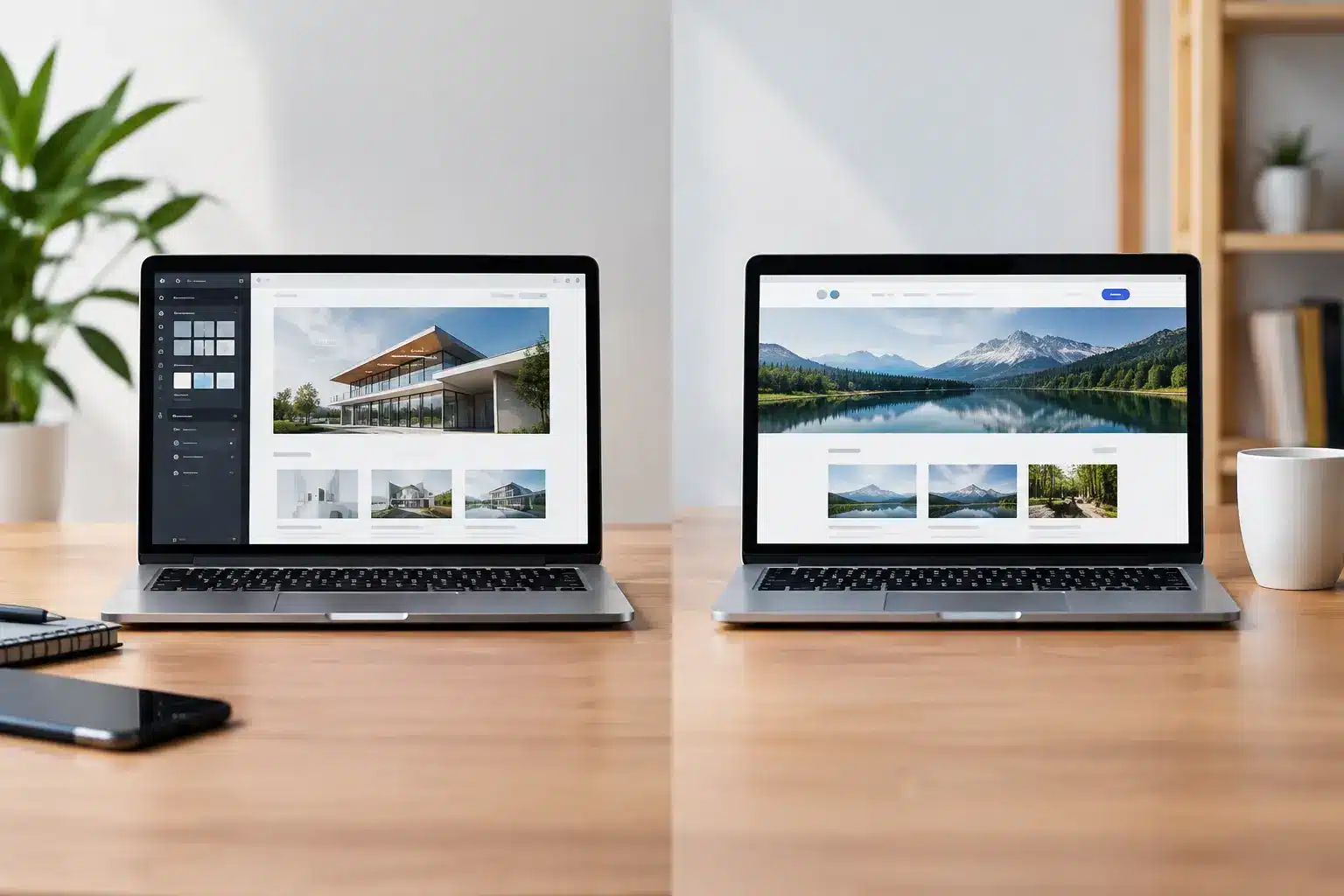
A website quote can look very different depending on what sits behind it. The choice between a custom website vs template website is not simply about paying more or less. It affects how your business is presented, how easily the site can grow, how quickly it can launch, and how much help you may need later.
For a local business in Stourbridge or the wider West Midlands, the right answer usually comes down to your aims. A sole trader who needs a professional online brochure has different priorities from a retailer taking payments online or a growing service business relying on regular enquiries. Understanding the practical differences helps you spend your budget where it will make the greatest difference.
What is a template website?
A template website starts with a pre-designed layout. The basic structure, page styles, fonts and features are already in place, then adapted with your logo, colours, copy, photographs and contact details. Templates are available through a range of website platforms and can be an efficient starting point for straightforward sites.
This does not have to mean a poor-quality website. A well-chosen template, properly configured and filled with strong content, can look professional, work well on mobile devices and give customers the information they need. For a new business, it can be a sensible way to establish a credible online presence without waiting months for a large build.
The limitation is that the design and functionality are shaped by the template’s existing framework. You can often change a great deal, but not everything. A feature that sounds simple, such as a tailored quote form, unusual product options or a specialist booking journey, may require compromises, paid add-ons or a different solution altogether.
What does a custom website involve?
A custom website is planned around your business rather than around a pre-existing page layout. Its structure, design and features are selected to support the actions you want visitors to take, whether that is calling your office, requesting a quotation, booking an appointment or buying a product.
The process normally begins with the essentials: who your customers are, what they need to find quickly, what makes you different, and which pages will support search visibility. The design can then reflect your brand rather than asking your brand to fit a theme. For example, a building contractor may need clear project galleries and service-area pages, while a professional firm may need to build trust through team profiles, accreditations and a simple enquiry route.
Custom does not always mean building every element from scratch. Good web design uses proven systems where they make sense. The difference is that those systems are chosen and configured around your requirements, not allowed to dictate them.
Custom website vs template website: the key differences
The first difference is cost. Template websites are usually less expensive at the outset because less design and development time is required. They are particularly effective when the site has a modest number of pages and familiar requirements, such as services, about us, contact details and a gallery.
A custom website needs more planning, design work and testing, so the initial investment is higher. However, it can avoid the cost of forcing unsuitable tools into a template later. If your business depends on specific user journeys, integrations or content that does not fit a standard layout, a tailored build can offer better value over time.
The second difference is flexibility. A template offers choices within set boundaries. This is perfectly acceptable when those boundaries match your needs. A custom site provides more control over layouts, calls to action, forms, navigation and future additions. That matters when a business expects to add locations, launch new services, build an online shop or connect the website to other systems.
The third difference is distinctiveness. Many templates are used by thousands of businesses. Your branding, photography and copy will still make the finished site feel like yours, but the underlying look may be familiar. With a custom design, the visual hierarchy and page experience can be created to reflect how your business works and what customers value.
Finally, there is performance and maintenance. Templates can include features you will never use, which may add unnecessary weight or complexity. Equally, a poorly built custom site can create maintenance problems. The important factor is not the label alone but whether the website has been built carefully, kept up to date and supported by someone who understands it.
When a template is the sensible choice
A template website can be the right option when speed and budget are your main considerations. If you are launching a new venture, replacing a dated one-page site, or need a clear online base while your business develops, a focused template site can do the job well.
It is especially suitable when your requirements are conventional. A local plumber, beautician, consultant or café may primarily need to show services, opening times, testimonials, location details and an easy way to get in touch. In those cases, clear messaging, strong mobile usability and reliable hosting often matter more than highly bespoke design features.
The key is to avoid treating a template as a box-ticking exercise. Customers will still judge the quality of your business by the quality of the website. Original copy, good photographs, sensible page structure, visible contact details and a clear next step make far more impact than decorative effects.
When a custom website is worth the investment
A custom website is usually a better fit when the website plays a central role in winning work or serving customers. This could include an ecommerce shop with varied products, a business with several services and target areas, or a company that needs detailed enquiry forms to qualify leads before the first conversation.
It is also valuable where your customer journey is not standard. Perhaps visitors need to compare services, upload information, make bookings, view case studies or move through a carefully planned sales process. A tailored site can make those journeys easier, reducing friction for customers and saving time for your team.
Growing businesses often benefit from custom work because it gives them a firmer foundation. It is easier to expand a site that has been planned with future pages, campaigns and search visibility in mind than to keep patching a layout that has reached its limits.
That said, a custom build is not a reason to overcomplicate things. A website should make it easier for a potential customer to understand what you offer and contact you. Extra functions only earn their place when they support that goal.
Think beyond the launch date
The most overlooked part of the decision is what happens after the website goes live. Domain renewal, hosting, security certificates, software updates, backups, content changes and search optimisation all need attention. A lower upfront price can become less attractive if you are left to solve technical issues alone or repeatedly pay for small alterations.
Ask who will own and manage the site, how updates will be handled, and whether you can add new content without rebuilding pages. For ecommerce sites, ask about product management, payment updates and ongoing security. For service businesses, consider whether landing pages, news posts or local SEO content will be needed as your marketing develops.
This is where working with a local, full-service provider can make the process easier. Web Design Stourbridge can support the wider picture, from the initial design through to hosting, maintenance and digital marketing, so the website is not treated as a one-off project that is forgotten after launch.
How to make the right choice for your business
Start with what the website must achieve in the next 12 to 24 months. If it needs to establish trust, explain a straightforward service and generate a manageable number of enquiries, a professionally adapted template may be ideal. If it needs to support ambitious growth, complex functionality or a distinctive customer experience, a custom website is more likely to justify its cost.
Be realistic about budget, but also about the cost of delay, lost enquiries and an online presence that no longer represents the quality of your work. The best website is not the most elaborate one. It is the one that gives your customers confidence, makes your business easy to choose and remains useful as your plans move forward.
A good first step is to write down the questions customers ask before they contact you. Those answers will often reveal whether you need a simple, well-structured starting point or a website designed around a more involved journey.