



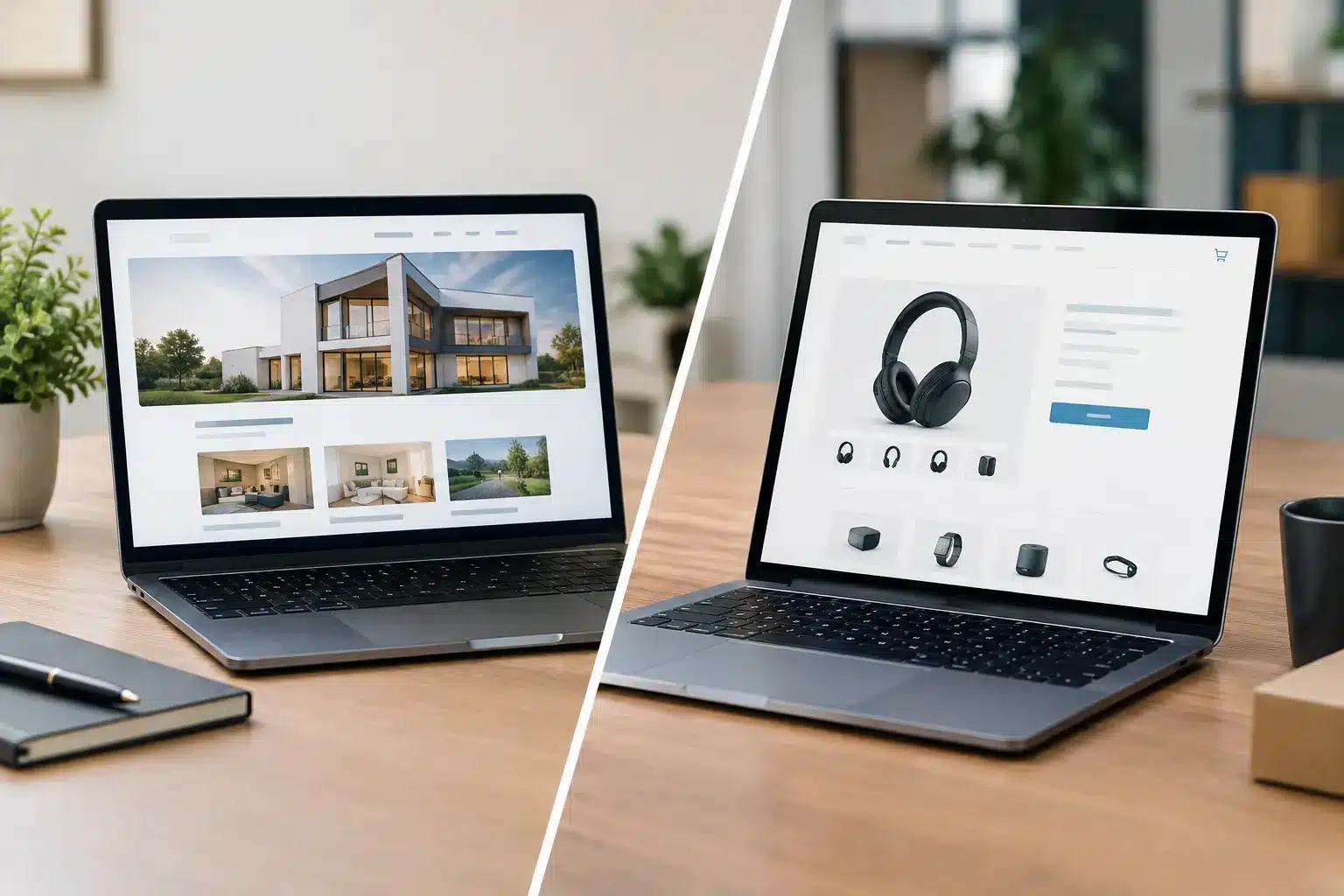
A builder in Stourbridge may need a website that brings in quotation requests, while an independent retailer may need to take payments and manage stock online. That is why the brochure site vs ecommerce decision should start with what your customers need to do, not with the latest website features.
Both options can be effective commercial tools. The right choice depends on how you sell, how much time you can give to managing the site, and where you want the business to be in the next few years.
What is a brochure website?
A brochure website presents your business, services and contact details online. Think of it as your always-available sales introduction. It explains who you are, what you do, where you work and why a customer should get in touch.
For many local businesses, the main purpose is to generate enquiries. A visitor might call, complete a contact form, request a quote or book a consultation. Tradespeople, professional services, local manufacturers, care providers, consultants and B2B companies often benefit from this approach.
A well-planned brochure site is much more than a digital business card. It can include detailed service pages, case studies, testimonials, a gallery, frequently asked questions, location information and clear calls to action. It can also be built with search visibility in mind, helping potential customers find you when they search for relevant services in Stourbridge or across the West Midlands.
Its strength is focus. Rather than asking visitors to browse a catalogue and complete a checkout, it guides them towards the next step that matters to your business: making an enquiry.
What is an ecommerce website?
An ecommerce website allows customers to buy products online. It includes product pages, a basket, secure checkout and online payment facilities. Depending on the business, it may also need product variations, delivery options, stock control, discount codes, customer accounts, returns information and integration with accounting or fulfilment systems.
Ecommerce is the natural choice if you sell physical goods that customers can confidently purchase without first speaking to you. It can also work well for digital products, tickets, subscriptions, bookings and standardised services.
The opportunity is clear: customers can buy outside normal opening hours, and your market is not limited to people passing your premises. However, ecommerce creates ongoing operational work. Products need accurate descriptions and photographs, stock levels must be kept current, and orders, delivery queries and returns need a reliable process behind them.
A shop can be a valuable growth channel, but it should not be treated as a set-and-forget website.
Brochure site vs ecommerce: the practical differences
The most obvious difference is how customers convert. On a brochure site, the conversion is usually an enquiry. On an ecommerce site, it is a completed order and payment. That single difference affects the cost, build time and level of support required.
A brochure website is generally quicker and more straightforward to launch. There are fewer moving parts, and content can concentrate on the questions customers ask before they choose a supplier. For a plumbing firm, for example, a clear emergency contact route and service-area pages may deliver more value than an online shop.
An ecommerce site needs more planning before it goes live. You will need to decide how products are organised, how delivery prices are calculated, what happens when stock is low, which payment methods to accept and who will process orders. Each detail is manageable, but together they require careful setup.
Security and maintenance also deserve attention. Every business website should be hosted securely, backed up and kept up to date. For ecommerce, this is particularly important because customers are sharing personal details and making payments. A professionally configured payment system helps protect both the business and its customers, but ongoing updates and checks remain part of responsible online trading.
When a brochure website is the better choice
A brochure site is often the sensible starting point when the sale is personal, bespoke or high value. If a customer needs a survey, a specification, a tailored quotation or reassurance before committing, an enquiry-led site reflects how the business actually operates.
It is also suitable when your service is local. A Stourbridge electrician, accountant or kitchen installer usually wants qualified leads in a defined area, rather than casual website visitors from across the country. Strong local service pages, genuine customer reviews and simple contact options can make that route highly effective.
Choose a brochure site if your priorities are to establish credibility, improve Google visibility, show recent work and make it easier for customers to contact you. It is often a better investment than building an online shop simply because competitors have one.
That does not mean the website has to remain basic. A brochure site can include online appointment requests, downloadable information, email sign-up forms, quote calculators or a small product catalogue without taking payments. These features can improve the customer journey while keeping your sales process under your control.
When ecommerce is worth the investment
Ecommerce makes sense when products have clear prices and customers are ready to buy without a lengthy conversation. A local gift retailer, specialist food supplier, clothing business or hobby shop may be able to turn existing demand into sales well beyond the high street.
It is especially useful if you already receive regular requests by telephone, social media messages or email for items that are easy to package and post. In that situation, an online shop can reduce repetitive admin and give customers a quicker way to order.
Before committing, be honest about the practical workload. You will need good product photography, helpful descriptions, clear delivery and returns policies, and someone who can update stock and respond to orders. If those foundations are not in place, a shop may look polished but create customer service problems.
Margins matter too. Payment processing, packaging, delivery, returns and advertising all affect profitability. Ecommerce can increase sales volume, but volume is only useful when each order remains worthwhile.
Could your business need both?
For many growing businesses, the answer is not strictly one or the other. A service business may have a brochure-led website while selling a small range of products, maintenance plans or gift vouchers online. A retailer may need rich pages about its expertise, story and local showroom alongside its product catalogue.
The key is to give each visitor a clear route. Someone researching a bespoke garden room may need to request a consultation. Someone buying a standard accessory may prefer to check out immediately. A website can support both journeys when it is planned around real customer behaviour.
Starting with a brochure site can also be a practical phased approach. Build the pages that establish trust and attract traffic first, then add ecommerce once product information, fulfilment and demand are ready. This avoids paying for functionality that the business is not yet equipped to use.
Questions to ask before choosing
Rather than choosing based on appearance alone, consider four practical questions:
- Do customers normally buy immediately, or do they ask questions and request a quote first?
- Are your prices fixed and your products easy to describe, package and deliver?
- Who will keep content, stock, orders and customer queries up to date?
- Is your immediate goal more enquiries, more direct sales, or a mixture of both?
Your answers will usually point to the right format. If the answer is mixed, a staged site or a combined approach may offer better value than forcing the business into a single model.
Build for the next stage, not just launch day
Whether you choose a brochure site or an online shop, the website should be mobile-friendly, easy to navigate and clear about what visitors should do next. It also needs dependable hosting, security, backups and ongoing maintenance. A website that is difficult to update soon becomes another task on an already busy list.
At Web Design Stourbridge, we help local businesses choose a website that fits their day-to-day operation as well as their ambitions. The aim is not to add features for the sake of it, but to create a site that supports enquiries, sales and future growth.
The best next step is to map out one real customer journey: how they find you, what they need to know before trusting you, and how they prefer to buy or make contact. Once that is clear, the right website choice becomes far easier to make.